

Scale without adding more system complexity
As portfolios, products and branches grow, disconnected tools create more hand-offs, more reconciliation and more operational overhead.
Rewafin brings LOS, LMS, Collections and ERP together in one AI-native platform for MFIs, NBFCs and co-operative banks — helping lending teams grow efficiently while keeping operations, risk and control connected.
As portfolios, products and branches grow, disconnected tools create more hand-offs, more reconciliation and more operational overhead.
Field teams, branches, DSAs, digital journeys and partner channels need to operate on the same borrower and loan data — not separate versions of it.
Credit policies, approvals, servicing rules and regulatory processes need to move with the business without becoming dependent on manual workarounds.
Leadership needs consistent visibility across products, branches and channels — from origination through servicing and recovery.
Rewafin adapts to different operating models — from field-led microfinance and multi-product NBFCs to CBS-connected co-operative banks and other specialised financial institutions.
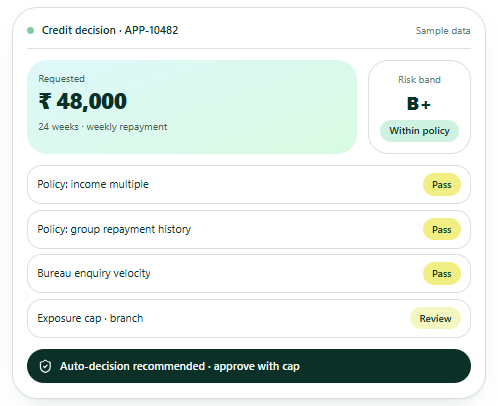
NBFCs
Manage products, customers and portfolios across branches, partners and digital channels — with configurable credit policies and specialised workflows for growing lending organisations.
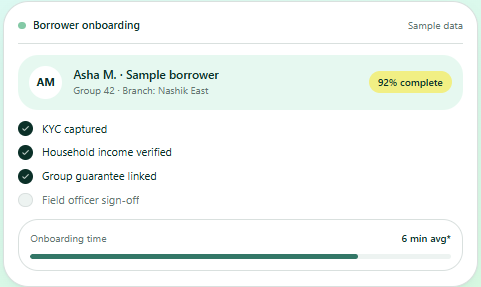
Microfinance Institutions
Run high-volume, low-ticket lending across centres, branches and field teams with connected workflows for borrower onboarding, group lending, verification and collections.
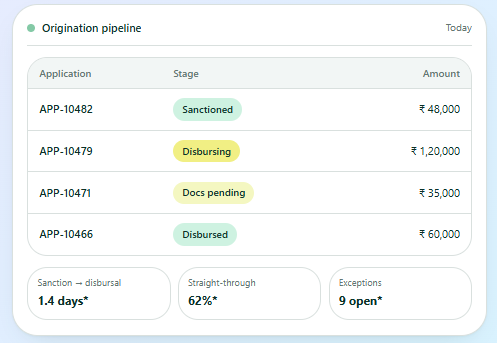
Co-operative Banks
Add a connected lending layer alongside your Core Banking System for origination, credit and loan servicing — without attempting to replace the bank’s existing core.
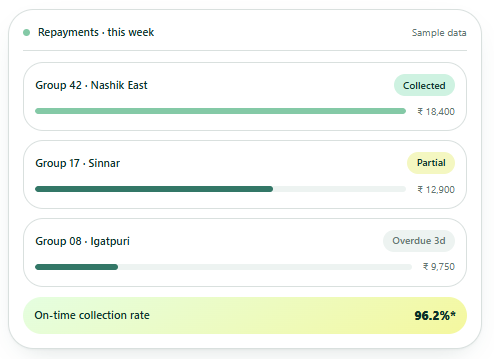
Other Financial Institutions
Use Rewafin’s modular lending foundation across specialised credit businesses that need configurable origination, servicing, collections and operational workflows without assembling multiple disconnected systems.
lower CapEx & OpEx
Replace fragmented lending systems with one modular platform across LOS, LMS, Collections and ERP — reducing duplicated technology, manual processes and operating complexity.
AI inside the workflow
Use intelligence where the work happens — helping teams assess risk, surface anomalies, prioritise exceptions and make more consistent decisions.
Faster movement from application to disbursal
Connected workflows reduce unnecessary hand-offs between sourcing, credit, operations and disbursement teams.
Greater control across the business
Configurable policies, role-based workflows and traceable actions give teams stronger control without relying on spreadsheets and offline approvals.
LOS, LMS, Collections and ERP operate as parts of the same platform — reducing duplicated data and disconnected workflows.
AI assists decisions, exception handling, workflow optimisation and risk monitoring inside the processes teams already use.
Products, policies, workflows and approvals can reflect differences across products, branches, channels and operating teams.
API-first by design — Lending OS slots into your existing stack instead of replacing it.
Still unsure? Our lending specialists are happy to walk you through a live MFI origination and collections flow.
Yes. Group linkages, guarantees and JLG workflows sit on the same borrower record as individual loans, so field officers capture once and the rest of the lifecycle reuses that data.
Offline-capable field capture syncs when connectivity returns. Applications, KYC and group linkages collected in the field land in the same structured data model as online origination.
Your lending policy runs as configuration, not code. Applications inside policy go straight through; exceptions route for review, with a full reasoning trail behind every outcome and override.
Portfolio, PAR and outstanding views update as work happens. Compare branches, products and officers, and export the reporting your board, lenders and regulators already ask for.
See how Rewafin brings LOS, LMS, Collections and ERP together to help your teams move faster, operate with greater control and scale without adding more system complexity.
